

Popular Products Guide
A Guide to Evaluating Popular Supplements for Men
The market for natural supplements for men is full of products that look similar but differ in important ways. This guide helps you understand what to look for when evaluating popular products for men, from label transparency to ingredient formats. We do not rank brands or recommend specific purchases. Instead, we give you a framework for comparing products on your own, using the same principles we apply when writing our ingredient pages.
Chapter One
Start with the supplement facts panel
Every supplement label includes a supplement facts panel, which lists the ingredients, the amount per serving, and the daily value percentage if one exists. This panel is the most objective source of information on the product.
Step One
Check the serving size first
The serving size determines how much of each ingredient you actually get. Many men read the ingredient list without checking the serving size, which can lead to incorrect comparisons. A product listing 500 mg per serving means something different if the serving size is one capsule versus three.
Step Two
Read the active ingredients
After confirming the serving size, move to the active ingredients list. Each entry should name the ingredient and specify the amount per serving. This is where you begin comparing what a product contains against what you are looking for in natural capsules for strength and vitality.
Step Three
Review the inactive ingredients
Inactive ingredients include binders, fillers, capsule materials, and flavorings. They do not contribute to the supplement's intended use, but they matter if you have dietary preferences or sensitivities. Reading the full panel — not just the headline ingredients — gives you a complete picture of the product.
Chapter Two
Ingredient transparency
Ingredient transparency means that a product label clearly lists what is in the container and in what amounts. Some products use a proprietary blend, which groups several ingredients under one name and lists only the total weight of the blend, not the amount of each ingredient.
Products that list each ingredient separately are easier to evaluate. We do not claim that blends are inherently lower quality, but we do note that they make it harder to know what you are taking. This is one of the most practical distinctions in the popular products for men category.
When a label groups five ingredients under a blend weight of 800 mg, you cannot tell whether each ingredient contributes 160 mg or whether one dominates the total. A label that breaks the same 800 mg into five individually listed amounts lets you compare each component against the research you have read and against competing products in the same category.
Vitamin supplements for men that disclose each ingredient amount give you a clearer basis for comparison. The distinction between a blend and a fully disclosed list is not about quality — it is about whether you have enough information to make an informed comparison at all.
Chapter Three
Standardized extracts
Many natural capsules for strength and vitality contain plant extracts described as standardized. This means the manufacturer targets a specific percentage of a marker compound in the extract.
For example, a label might say ashwagandha extract standardized to 5% withanolides. That language tells you the extract is measured against a known compound, so two batches are more consistent.
A higher percentage is not automatically better. It is a piece of information that helps you know what you are buying and compare two products that use different standardization levels.
Chapter Four
Format and delivery
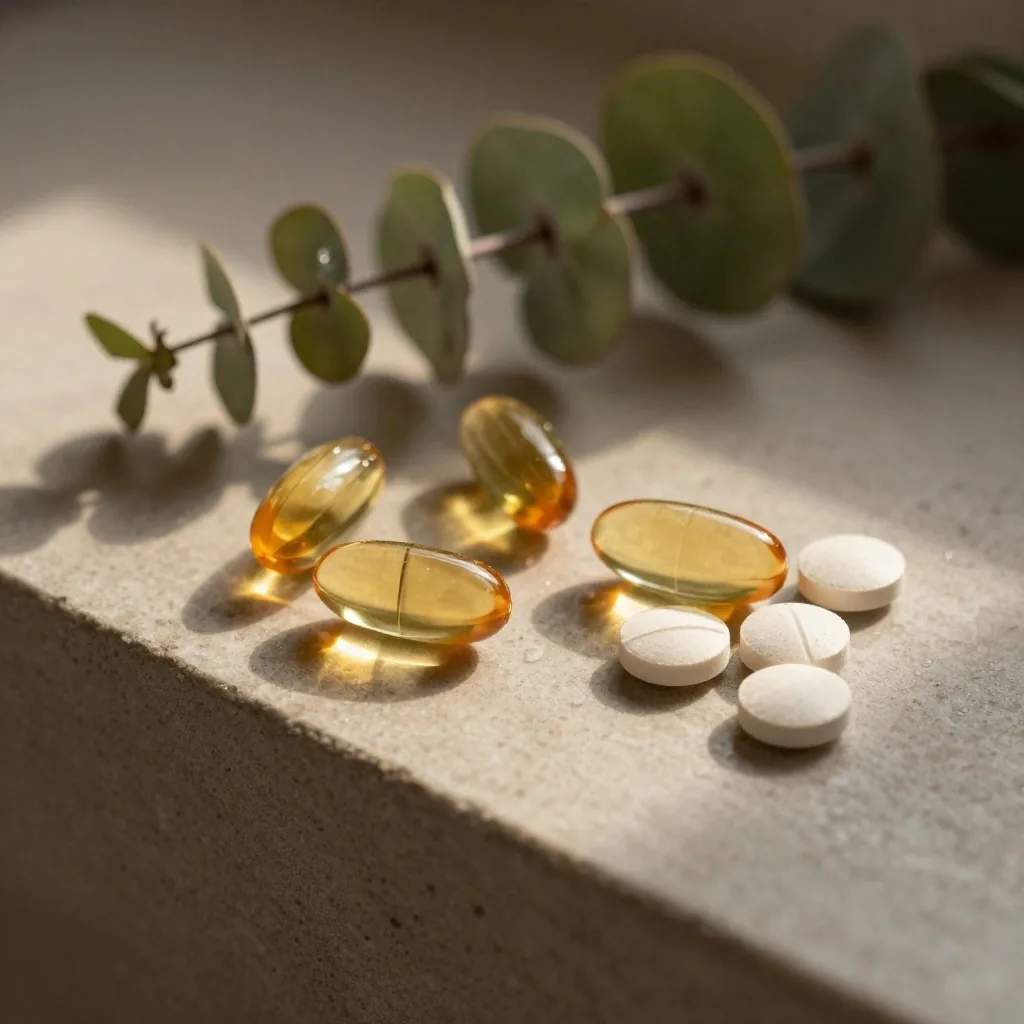
Supplements come in several formats, including capsules, softgels, tablets, powders, and liquids. The format affects how the product is used, how it is stored, and sometimes how the label presents ingredient amounts.
Capsules
Dry powder inside a gelatin or cellulose shell. Easy to swallow and common for herbal extracts and single-ingredient products.
Softgels
Often used for oil-based ingredients like vitamin D or fish oil. The sealed shell protects the contents from oxidation.
Tablets
Compressed dry powder blends. Common for vitamins and minerals for men. Cost-effective but sometimes larger and harder to swallow.
Powders
Mixed into water or smoothies. Allow flexible dosing and are common in energy and endurance supplements.
Liquids
Pre-measured doses or dropper-based servings. Useful when you need to adjust the amount per serving in small increments.
Some formats are easier to swallow, some are easier to travel with, and some allow for more flexible dosing. The choice depends on what you are taking and how it fits your day. No format is universally better than another.
Chapter Five
Third-party testing and quality claims
Some supplement labels mention third-party testing or quality certifications. We explain what these claims mean and what they do not mean. A third-party test may verify that the product contains the ingredients listed on the label, but it does not mean the product is more effective.
What a claim may verify
- — The label ingredients match what is in the container
- — The product is free of specific contaminants tested for
- — The manufacturing facility follows documented standards
What a claim does not tell you
- — Whether the product works better than one without the seal
- — Whether the ingredient amounts are optimal for your needs
- — Whether the product is appropriate for your routine
We do not invent certifications or claim that any product is safer or better because of a seal on the label. We describe what the label says and what context a reader needs to interpret it accurately.
Chapter Seven
Red flags on a label
Some label language is a signal to slow down and ask more questions. This section is not about judging brands, but about giving you a filter for what to watch for when you read a label. If a product makes claims that sound too specific or too dramatic, that is a reason to look more closely, not to buy quickly.
Claims that sound medical
Supplements are not intended to diagnose, cure, or prevent any condition. Labels that imply otherwise are overstepping the category.
Promises of rapid body changes
Wellness is built through consistent daily habits. Labels promising dramatic results in a short time frame are marketing, not information.
Missing ingredient amounts
If a label names an ingredient but does not say how much is in each serving, you cannot compare it against other products or against what you are looking for.
No serving size listed
Without a serving size, every other number on the label loses its reference point. This is a basic omission that makes a product hard to evaluate.
Terms like miracle or breakthrough
These words are not useful on a supplement label. They signal that the product is being marketed aggressively rather than informatively.
Clinically proven phrasing
Without a reference to a specific study, this phrase is decorative. A label that cites research should tell you where to find it.
Chapter Eight
Building your own checklist
After reading this guide, you should be able to build a simple checklist for evaluating any supplement product. This is the same approach we use when researching products for our content pages.
The checklist is not a guarantee of quality, but it is a reliable way to compare products and avoid common label traps. Bring it on your next store visit or keep it open when browsing online.
Your Evaluation Checklist
-
Is the serving size clear? Confirm the amount per serving before reading anything else on the panel.
-
Are ingredients listed individually or as a blend? Individual listings give you enough information to compare. Blends hide the per-ingredient amounts.
-
Are extract standardizations specified? Look for a marker compound and a percentage when the product contains plant extracts.
-
Is the format appropriate for the ingredient? Softgels for oils, tablets for dry blends, powders for flexible dosing. Match format to your routine.
-
Does the label avoid medical claims? Phrases like miracle, breakthrough, or rapid results are marketing language, not information.
Guide Complete
You now have a framework for comparing any product on the shelf
Use the checklist above on your next store visit or online search. The goal is not to find the best product, but to compare accurately and make your own informed decision.